


Page 284 - Social Enterprise A New Business Paradigm for Thailand
P. 284
(2) The Siam Cement Public Company Limited (SCG)

                  The Siam Cement Public Company Limited, commonly known as SCG, operates within the same
                  industrial sector as PTT, an extractive industry that sources raw materials from the earth, such

                  as oil, coal, and various minerals. As a result, its production processes often involve drilling,
                  pumping, and blasting soil or rock for mining. In this context, SCG has acknowledged the critical
                  responsibility  it  bears  in  addressing  global  warming,  climate  change,  environmental
                  degradation, inefficient use of energy and resources, and broader concerns related to quality
                  of life and workplace safety. These challenges must be tackled in parallel with the company’s
                  efforts to grow its business amid evolving environmental, social, and technological conditions.
                  To this end, SCG has developed a sustainability strategy centered on three key dimensions:
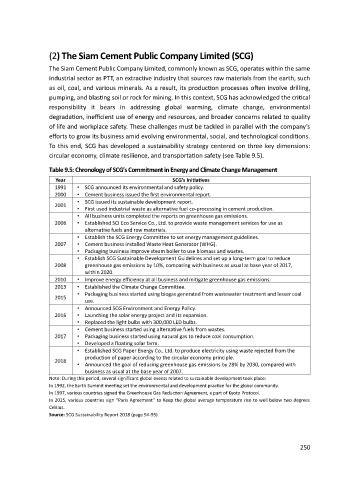
                  circular economy, climate resilience, and transportation safety (see Table 9.5).

                  Table 9.5: Chronology of SCG’s Commitment in Energy and Climate Change Management

                     Year                                     SCG’s Initiatives
                    1991    •  SCG announced its environmental and safety policy.
                    2000    •  Cement business issued the first environmental report.
                            •  SCG issued its sustainable development report.
                    2001
                            •  First used industrial waste as alternative fuel co-processing in cement production.
                            •  All business units completed the reports on greenhouse gas emissions.
                    2006    •  Established SCI Eco Service Co., Ltd. to provide waste management services for use as
                               alternative fuels and raw materials.
                            •  Establish the SCG Energy Committee to set energy management guidelines.
                    2007    •  Cement business installed Waste Heat Generator (WHG).
                            •  Packaging business improve steam boiler to use biomass and wastes.
                            •  Establish SCG Sustainable Development Guidelines and set up a long-term goal to reduce
                    2008       greenhouse gas emissions by 10%, comparing with business as usual at base year of 2017,
                               within 2020.
                    2010    •  Improve energy efficiency at all business and mitigate greenhouse gas emissions.
                    2013    •  Established the Climate Change Committee.
                            •  Packaging business started using biogas generated from wastewater treatment and lesser coal
                    2015
                               use.
                            •  Announced SCG Environment and Energy Policy.
                    2016    •  Launching the solar energy project and its expansion.
                            •  Replaced the light bulbs with 300,000 LED bulbs.
                            •  Cement business started using alternative fuels from wastes.
                    2017    •  Packaging business started using natural gas to reduce coal consumption.
                            •  Developed a floating solar farm.
                            •  Established SCG Paper Energy Co., Ltd. to produce electricity using waste rejected from the
                               production of paper according to the circular economy principle.
                    2018
                            •  Announced the goal of reducing greenhouse gas emissions by 28% by 2030, compared with
                               business as usual at the base year of 2007.
                  Note: During this period, several significant global events related to sustainable development took place:
                  In 1992, the Earth Summit meeting set the environmental and development practice for the global community.
                  In 1997, various countries signed the Greenhouse Gas Reduction Agreement, a part of Kyoto Protocol.
                  In 2025, various countries sign “Paris Agreement” to Keep the global average temperature rise to well below two degrees
                  Celsius.
                  Source: SCG Sustainability Report 2018 (page 94-95)


                                                                                                          250

