


Page 295 - Social Enterprise A New Business Paradigm for Thailand
P. 295
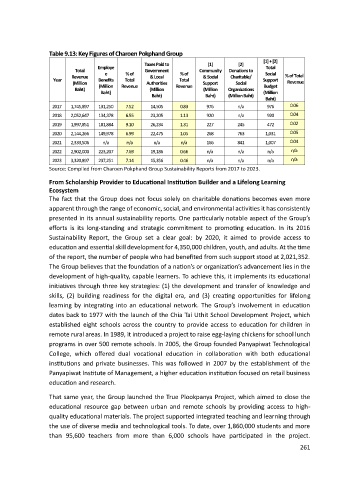
Table 9.13: Key Figures of Charoen Pokphand Group
                                                                                              [1] + [2]
                                                    Taxes Paid to         [1]        [2]
                                   Employe                                                    Total
                           Total      e      % of   Government   % of   Community   Donations to   Social
                    Year   Revenue   Benefits    Total   & Local   Total   & Social   Charitable/   Support   % of Total
                                                                                                      Revenue
                           (Million         Revenue   Authorities    Revenue   Support   Social
                           Baht)    (Million          (Million          (Million   Organizations   Budget
                                    Baht)                                                     (Million
                                                      Baht)              Baht)   (Million Baht)
                                                                                              Baht)
                   2017   1,745,897   131,250   7.52   14,505   0.83      976        n/a       976     0.06
                   2018   2,052,647   134,378   6.55   23,205   1.13      920        n/a       920     0.04
                   2019   1,997,851   181,884   9.10   26,234   1.31      227       245        472     0.02
                   2020   2,144,266   149,978   6.99   22,475   1.05      268       763       1,031    0.05
                   2021   2,333,506   n/a    n/a       n/a       n/a      166       841       1,007    0.04
                   2022   2,902,000   223,207   7.69   19,186   0.66      n/a        n/a       n/a     n/a
                   2023   3,320,897   237,251   7.14   15,356   0.46      n/a        n/a       n/a     n/a
                  Source: Compiled from Charoen Pokphand Group Sustainability Reports from 2017 to 2023.

                  From Scholarship Provider to Educational Institution Builder and a Lifelong Learning
                  Ecosystem
                  The fact that the Group does not focus solely on charitable donations becomes even more
                  apparent through the range of economic, social, and environmental activities it has consistently
                  presented in its annual sustainability reports. One particularly notable aspect of the Group’s
                  efforts  is  its  long-standing  and  strategic  commitment  to  promoting  education.  In  its  2016
                  Sustainability  Report,  the  Group  set  a  clear  goal:  by  2020,  it  aimed  to  provide  access  to

                  education and essential skill development for 4,350,000 children, youth, and adults. At the time
                  of the report, the number of people who had benefited from such support stood at 2,021,352.
                  The Group believes that the foundation of a nation’s or organization’s advancement lies in the
                  development of high-quality, capable learners. To achieve this, it implements its educational
                  initiatives through three key strategies: (1) the development and transfer of knowledge and
                  skills,  (2)  building  readiness  for  the  digital  era,  and  (3)  creating  opportunities  for  lifelong
                  learning  by  integrating  into  an  educational  network.  The  Group’s involvement  in  education
                  dates back to 1977 with the launch of the Chia Tai Uthit School Development Project, which
                  established  eight  schools  across  the country  to provide  access  to education  for children  in

                  remote rural areas. In 1989, it introduced a project to raise egg-laying chickens for school lunch
                  programs in over 500 remote schools. In 2005, the Group founded Panyapiwat Technological
                  College,  which  offered  dual  vocational  education  in  collaboration  with  both  educational
                  institutions  and  private businesses.  This was  followed  in  2007  by  the  establishment  of  the
                  Panyapiwat Institute of Management, a higher education institution focused on retail business
                  education and research.

                  That same year, the Group launched the True Plookpanya Project, which aimed to close the
                  educational  resource  gap  between  urban  and  remote  schools  by  providing  access  to  high-

                  quality educational materials. The project supported integrated teaching and learning through
                  the use of diverse media and technological tools. To date, over 1,860,000 students and more
                  than  95,600  teachers  from  more  than  6,000  schools  have  participated  in  the  project.
                                                                                                          261

