


Page 297 - Social Enterprise A New Business Paradigm for Thailand
P. 297
•  Stock Exchange of Thailand plays an influential role: The development and significance of
                      ESG have steadily advanced since 2001, when ESG principles and corporate governance
                      guidelines were first introduced for publicly listed companies.

                  •  Greater transparency: In 2023, a total of 692 publicly listed companies, representing 76%
                      of all listed firms, disclosed ESG information through publicly accessible online platforms.

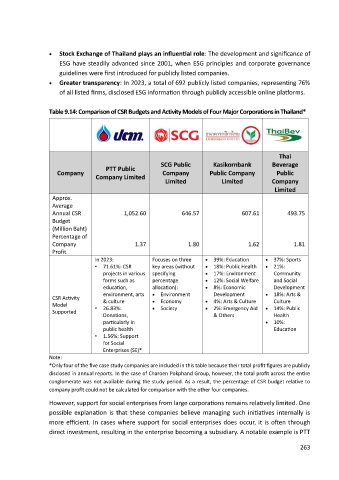
                  Table 9.14: Comparison of CSR Budgets and Activity Models of Four Major Corporations in Thailand*


                                                                                                   Thai
                                                          SCG Public        Kasikornbank         Beverage
                                      PTT Public
                     Company                              Company          Public Company         Public
                                   Company Limited
                                                           Limited             Limited           Company
                                                                                                 Limited
                   Approx.
                   Average
                   Annual CSR                1,052.60            646.57               607.61          493.75
                   Budget
                   (Million Baht)
                   Percentage of
                   Company                      1.37               1.80                 1.62            1.81
                   Profit
                                  In 2023:             Focuses on three   •  39%: Education   •  37%: Sports
                                  •  71.61%: CSR       key areas (without   •  18%: Public Health    •  21%:
                                     projects in various   specifying    •  17%: Environment     Community
                                     forms such as     percentage        •  12%: Social Welfare     and Social
                                     education,        allocation):      •  8%: Economic         Development
                                     environment, arts   •  Environment     Development       •  18%: Arts &
                   CSR Activity      & culture         •  Economy        •  4%: Arts & Culture    Culture
                   Model          •  26.83%:           •  Society        •  2%: Emergency Aid   •  14%: Public
                   Supported
                                     Donations,                             & Others             Health
                                     particularly in                                          •  10%:
                                     public health                                               Education
                                  •  1.56%: Support
                                     for Social
                                     Enterprises (SE)*
                  Note:
                  *Only four of the five case study companies are included in this table because their total profit figures are publicly
                  disclosed in annual reports. In the case of Charoen Pokphand Group, however, the total profit across the entire
                  conglomerate was not available during the study period. As a result, the percentage of CSR budget relative to
                  company profit could not be calculated for comparison with the other four companies.

                  However, support for social enterprises from large corporations remains relatively limited. One
                  possible  explanation  is  that  these  companies believe  managing  such  initiatives  internally is
                  more efficient. In cases where support for social enterprises does  occur, it is often through
                  direct investment, resulting in the enterprise becoming a subsidiary. A notable example is PTT

                                                                                                          263

