


Page 259 - Social Enterprise A New Business Paradigm for Thailand
P. 259
more than 10% of the variance: total income, net profit, current ratio, and return on assets
                  (ROA). A summary of findings for each of these indicators is presented below.


                  8.7.1 Factors Predicting Total Income in Social Enterprises


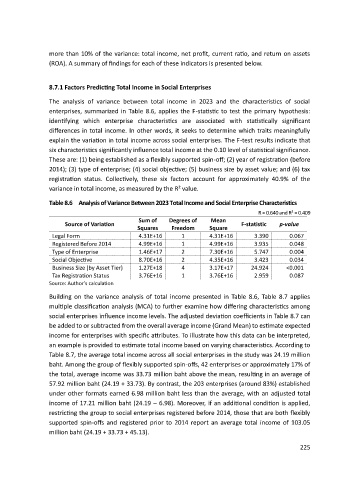
                  The  analysis  of  variance  between  total  income  in  2023  and  the  characteristics  of  social
                  enterprises, summarized in Table 8.6, applies the F-statistic to test the primary hypothesis:
                  identifying  which  enterprise  characteristics  are  associated  with  statistically  significant
                  differences in total income. In other words, it seeks to determine which traits meaningfully
                  explain the variation in total income across social enterprises. The F-test results indicate that
                  six characteristics significantly influence total income at the 0.10 level of statistical significance.
                  These are: (1) being established as a flexibly supported spin-off; (2) year of registration (before
                  2014); (3) type of enterprise; (4) social objective; (5) business size by asset value; and (6) tax
                  registration  status.  Collectively,  these  six  factors  account  for  approximately  40.9%  of  the

                  variance in total income, as measured by the R² value.

                  Table 8.6  Analysis of Variance Between 2023 Total Income and Social Enterprise Characteristics
                                                                                                       2
                                                                                            R = 0.640 and R  = 0.409
                                                  Sum of    Degrees of     Mean
                        Source of Variation                                           F-statistic   p-value
                                                 Squares     Freedom       Square
                   Legal Form                     4.31E+16       1         4.31E+16       3.390        0.067
                   Registered Before 2014         4.99E+16       1         4.99E+16       3.935        0.048
                   Type of Enterprise             1.46E+17       2         7.30E+16       5.747        0.004
                   Social Objective               8.70E+16       2         4.35E+16       3.423        0.034
                   Business Size (by Asset Tier)   1.27E+18      4         3.17E+17      24.924       <0.001
                   Tax Registration Status        3.76E+16       1         3.76E+16       2.959        0.087
                  Source: Author’s calculation
                  Building  on  the  variance  analysis  of  total  income  presented  in  Table  8.6,  Table  8.7  applies
                  multiple classification analysis (MCA) to further examine how differing characteristics among

                  social enterprises influence income levels. The adjusted deviation coefficients in Table 8.7 can
                  be added to or subtracted from the overall average income (Grand Mean) to estimate expected
                  income for enterprises with specific attributes. To illustrate how this data can be interpreted,
                  an example is provided to estimate total income based on varying characteristics. According to
                  Table 8.7, the average total income across all social enterprises in the study was 24.19 million
                  baht. Among the group of flexibly supported spin-offs, 42 enterprises or approximately 17% of
                  the total, average income was 33.73 million baht above the mean, resulting in an average of

                  57.92 million baht (24.19 + 33.73). By contrast, the 203 enterprises (around 83%) established
                  under other formats earned 6.98 million baht less than the average, with an adjusted total
                  income of 17.21 million baht (24.19 – 6.98). Moreover, if an additional condition is applied,
                  restricting the group to social enterprises registered before 2014, those that are both flexibly
                  supported  spin-offs  and  registered prior  to  2014  report  an average  total  income  of  103.05
                  million baht (24.19 + 33.73 + 45.13).

                                                                                                          225

