


Page 55 - Social Enterprise A New Business Paradigm for Thailand
P. 55
ecosystem, motivations, challenges, and interrelations among various types of social businesses.
               Participants were identified using the snowball sampling method.

               3. Value Chain Analysis
               Using the same interview methodology, the study also conducted a value chain analysis, with a
               specific focus on social businesses in the coffee industry, to explore potential opportunities and

               long-term sustainability.

               4. Quantitative and Econometric Analysis
               The study performed a financial and econometric analysis using available data from government
               databases covering the entire population of legally registered social enterprises. This component
               aimed to assess their financial sustainability. Detailed methodology for this analysis is provided in
               the  relevant  chapter.  Any  hypotheses  and  corresponding  analytical  approaches  are  also
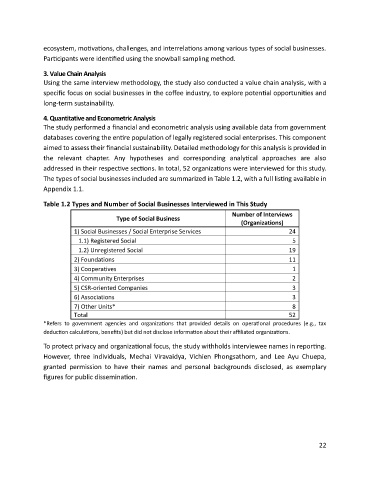
               addressed in their respective sections. In total, 52 organizations were interviewed for this study.
               The types of social businesses included are summarized in Table 1.2, with a full listing available in
               Appendix 1.1.

               Table 1.2 Types and Number of Social Businesses Interviewed in This Study

                                                                              Number of Interviews
                                        Type of Social Business
                                                                                 (Organizations)
                          1) Social Businesses / Social Enterprise Services                      24
                             1.1) Registered Social                                               5
                             1.2) Unregistered Social                                            19
                          2) Foundations                                                         11
                          3) Cooperatives                                                         1
                          4) Community Enterprises                                                2
                          5) CSR-oriented Companies                                               3
                          6) Associations                                                         3
                          7) Other Units*                                                         8
                          Total                                                                  52
               *Refers  to  government  agencies  and  organizations  that  provided  details  on  operational  procedures  (e.g.,  tax
               deduction calculations, benefits) but did not disclose information about their affiliated organizations.

               To protect privacy and organizational focus, the study withholds interviewee names in reporting.
               However,  three  individuals,  Mechai  Viravaidya,  Vichien  Phongsathorn,  and  Lee  Ayu  Chuepa,
               granted  permission  to  have  their  names  and  personal  backgrounds  disclosed,  as  exemplary
               figures for public dissemination.


                                                                                                           22

