


Page 51 - Social Enterprise A New Business Paradigm for Thailand
P. 51
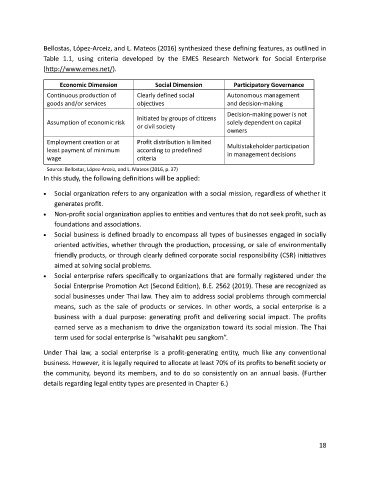
Bellostas, López-Arceiz, and L. Mateos (2016) synthesized these defining features, as outlined in
               Table  1.1,  using  criteria  developed  by  the  EMES  Research  Network  for  Social  Enterprise

               (http://www.emes.net/).

                     Economic Dimension             Social Dimension          Participatory Governance
                 Continuous production of     Clearly defined social        Autonomous management
                 goods and/or services        objectives                    and decision-making
                                                                            Decision-making power is not
                                              Initiated by groups of citizens
                 Assumption of economic risk                                solely dependent on capital
                                              or civil society
                                                                            owners
                 Employment creation or at    Profit distribution is limited   Multistakeholder participation
                 least payment of minimum     according to predefined
                 wage                         criteria                      in management decisions
                 Source: Bellostas, López-Arceiz, and L. Mateos (2016, p. 37)

               In this study, the following definitions will be applied:

               •  Social organization refers to any organization with a social mission, regardless of whether it
                   generates profit.

               •  Non-profit social organization applies to entities and ventures that do not seek profit, such as
                   foundations and associations.
               •  Social business is defined broadly to encompass all types of businesses engaged in socially
                   oriented activities, whether through the production, processing, or sale of environmentally
                   friendly products, or through clearly defined corporate social responsibility (CSR) initiatives
                   aimed at solving social problems.
               •  Social enterprise refers specifically to organizations that are formally registered under the
                   Social Enterprise Promotion Act (Second Edition), B.E. 2562 (2019). These are recognized as
                   social businesses under Thai law. They aim to address social problems through commercial

                   means,  such  as  the  sale  of  products  or  services.  In  other  words,  a  social  enterprise  is  a
                   business  with  a  dual  purpose:  generating  profit  and  delivering  social  impact.  The  profits
                   earned serve as a mechanism to drive the organization toward its social mission. The Thai
                   term used for social enterprise is “wisahakit peu sangkom”.

               Under  Thai  law,  a  social  enterprise  is  a  profit-generating  entity,  much  like  any  conventional
               business. However, it is legally required to allocate at least 70% of its profits to benefit society or
               the community, beyond  its  members,  and  to  do  so  consistently on  an  annual  basis.  (Further
               details regarding legal entity types are presented in Chapter 6.)


                                                                                                           18

