


Page 50 - Social Enterprise A New Business Paradigm for Thailand
P. 50
are driven by social entrepreneurs. Others evolve from large corporations with Corporate Social
               Responsibility (CSR) initiatives that choose to create dedicated units or spin-offs with greater

               flexibility and long-term sustainability. In both cases, these organizations are profit-generating but
               remain firmly anchored to their social missions. They balance the pursuit of financial stability with
               a strong commitment to social impact and sustainable development.

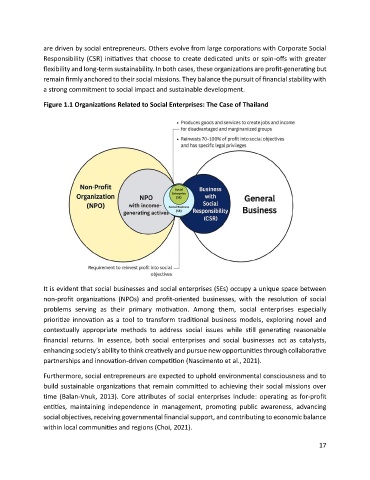
               Figure 1.1 Organizations Related to Social Enterprises: The Case of Thailand


               It is evident that social businesses and social enterprises (SEs) occupy a unique space between
               non-profit  organizations  (NPOs)  and  profit-oriented  businesses,  with  the  resolution  of  social
               problems  serving  as  their  primary  motivation.  Among  them,  social  enterprises  especially
               prioritize  innovation  as  a  tool  to  transform  traditional  business  models,  exploring  novel  and
               contextually  appropriate  methods  to  address  social  issues  while  still  generating  reasonable

               financial  returns.  In  essence,  both  social  enterprises  and  social  businesses  act  as  catalysts,
               enhancing society’s ability to think creatively and pursue new opportunities through collaborative
               partnerships and innovation-driven competition (Nascimento et al., 2021).

               Furthermore, social entrepreneurs are expected to uphold environmental consciousness and to
               build sustainable organizations that remain committed to achieving their social missions over
               time  (Balan-Vnuk,  2013).  Core  attributes  of  social  enterprises  include: operating  as  for-profit
               entities,  maintaining  independence  in  management,  promoting  public  awareness,  advancing
               social objectives, receiving governmental financial support, and contributing to economic balance

               within local communities and regions (Choi, 2021).

                                                                                                           17

