


Page 223 - Social Enterprise A New Business Paradigm for Thailand
P. 223
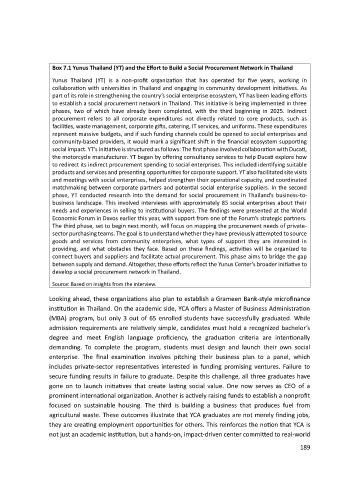
Box 7.1 Yunus Thailand (YT) and the Effort to Build a Social Procurement Network in Thailand

                   Yunus  Thailand  (YT)  is  a  non-profit  organization  that  has  operated  for  five  years,  working  in
                   collaboration with universities in Thailand and engaging in community development initiatives. As
                   part of its role in strengthening the country’s social enterprise ecosystem, YT has been leading efforts
                   to establish a social procurement network in Thailand. This initiative is being implemented in three
                   phases,  two  of  which  have  already  been  completed,  with  the  third  beginning  in  2025.  Indirect
                   procurement  refers  to  all  corporate  expenditures  not  directly  related  to  core  products,  such  as
                   facilities, waste management, corporate gifts, catering, IT services, and uniforms. These expenditures
                   represent massive budgets, and if such funding channels could be opened to social enterprises and
                   community-based providers, it would mark a significant shift in the financial ecosystem supporting
                   social impact. YT’s initiative is structured as follows: The first phase involved collaboration with Ducati,
                   the motorcycle manufacturer. YT began by offering consultancy services to help Ducati explore how
                   to redirect its indirect procurement spending to social enterprises. This included identifying suitable
                   products and services and presenting opportunities for corporate support. YT also facilitated site visits
                   and meetings with social enterprises, helped strengthen their operational capacity, and coordinated
                   matchmaking between corporate partners and potential social enterprise suppliers. In the second
                   phase, YT conducted research into the demand for social procurement in Thailand’s business-to-
                   business landscape. This involved interviews with approximately 85 social enterprises about their
                   needs and experiences in selling to institutional buyers. The findings were presented at the World
                   Economic Forum in Davos earlier this year, with support from one of the Forum’s strategic partners.
                   The third phase, set to begin next month, will focus on mapping the procurement needs of private-
                   sector purchasing teams. The goal is to understand whether they have previously attempted to source
                   goods  and  services  from  community  enterprises,  what  types  of  support  they  are  interested  in
                   providing,  and  what  obstacles  they  face.  Based  on  these  findings,  activities  will  be  organized  to
                   connect buyers and suppliers and facilitate actual procurement. This phase aims to bridge the gap
                   between supply and demand. Altogether, these efforts reflect the Yunus Center’s broader initiative to
                   develop a social procurement network in Thailand.

                   Source: Based on insights from the interview.

                  Looking ahead, these organizations also plan to establish a Grameen Bank-style microfinance
                  institution in Thailand. On the academic side, YCA offers a Master of Business Administration
                  (MBA) program, but only 3 out of 65 enrolled students have successfully graduated. While
                  admission requirements are relatively simple, candidates must hold a recognized bachelor’s
                  degree  and  meet  English  language  proficiency,  the  graduation  criteria  are  intentionally

                  demanding.  To  complete  the  program,  students  must  design  and  launch  their  own  social
                  enterprise.  The  final  examination  involves  pitching  their  business  plan  to  a  panel,  which
                  includes  private-sector  representatives  interested  in  funding  promising  ventures.  Failure  to
                  secure funding results in failure to graduate. Despite this challenge, all three graduates have
                  gone  on  to  launch  initiatives  that  create  lasting  social  value.  One  now  serves  as  CEO  of  a
                  prominent international organization. Another is actively raising funds to establish a nonprofit
                  focused  on  sustainable  housing.  The  third  is  building  a  business  that  produces  fuel  from
                  agricultural waste. These outcomes illustrate that YCA graduates are not merely finding jobs,
                  they are creating employment opportunities for others. This reinforces the notion that YCA is
                  not just an academic institution, but a hands-on, impact-driven center committed to real-world

                                                                                                          189

