


Page 207 - Social Enterprise A New Business Paradigm for Thailand
P. 207
(5) Limited companies registered as social enterprises are allowed to issue and offer shares to
                  the public without the need to submit applications, disclosure forms, or supporting documents
                  to the Securities and Exchange Commission (SEC). For some entrepreneurs, such as Dhamma

                  Business Social Enterprise Co., Ltd., this benefit is considered the most critical, as access to
                  fundraising is essential for the survival and growth of social enterprises.

                  In the end, it is important to recognize that the Social Enterprise Promotion Act is only one part
                  of  the  broader  ecosystem  supporting  the  growth  of  social  businesses.  There  are  also
                  mechanisms under other laws that help facilitate social enterprise activities. For instance, one
                  of the Act’s key objectives, promoting employment opportunities for individuals in need of
                  special support, can also be advanced through the Persons with Disabilities Empowerment Act,
                  B.E. 2550 (2007). This law requires businesses of a certain size to either hire persons with
                  disabilities or take alternative measures, such as contributing to the Fund for Empowerment of

                  Persons with Disabilities or supporting vocational initiatives for persons with disabilities (see
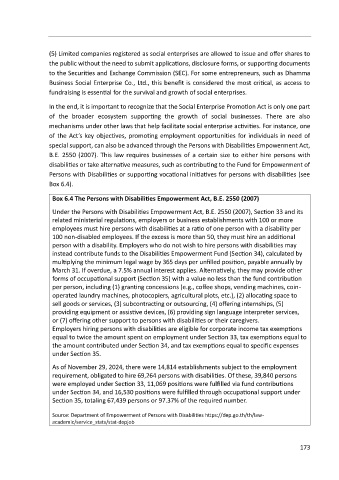
                  Box 6.4).

                   Box 6.4 The Persons with Disabilities Empowerment Act, B.E. 2550 (2007)

                   Under the Persons with Disabilities Empowerment Act, B.E. 2550 (2007), Section 33 and its
                   related ministerial regulations, employers or business establishments with 100 or more
                   employees must hire persons with disabilities at a ratio of one person with a disability per
                   100 non-disabled employees. If the excess is more than 50, they must hire an additional
                   person with a disability. Employers who do not wish to hire persons with disabilities may
                   instead contribute funds to the Disabilities Empowerment Fund (Section 34), calculated by
                   multiplying the minimum legal wage by 365 days per unfilled position, payable annually by
                   March 31. If overdue, a 7.5% annual interest applies. Alternatively, they may provide other
                   forms of occupational support (Section 35) with a value no less than the fund contribution
                   per person, including (1) granting concessions (e.g., coffee shops, vending machines, coin-
                   operated laundry machines, photocopiers, agricultural plots, etc.), (2) allocating space to
                   sell goods or services, (3) subcontracting or outsourcing, (4) offering internships, (5)
                   providing equipment or assistive devices, (6) providing sign language interpreter services,
                   or (7) offering other support to persons with disabilities or their caregivers.
                   Employers hiring persons with disabilities are eligible for corporate income tax exemptions
                   equal to twice the amount spent on employment under Section 33, tax exemptions equal to
                   the amount contributed under Section 34, and tax exemptions equal to specific expenses
                   under Section 35.

                   As of November 29, 2024, there were 14,814 establishments subject to the employment
                   requirement, obligated to hire 69,264 persons with disabilities. Of these, 39,840 persons
                   were employed under Section 33, 11,069 positions were fulfilled via fund contributions
                   under Section 34, and 16,530 positions were fulfilled through occupational support under
                   Section 35, totaling 67,439 persons or 97.37% of the required number.

                   Source: Department of Empowerment of Persons with Disabilities https://dep.go.th/th/law-
                   academic/service_stats/stat-depjob


                                                                                                          173

