


Page 231 - Social Enterprise A New Business Paradigm for Thailand
P. 231
communities  and  forge  inter-community  linkages;  and  5)  most  importantly,  citizens  and
                  community enterprises, who served as product owners, producers, and service providers. At
                  the national level, Pracharath Rak Samakkee Social Enterprise (Thailand) Co., Ltd. functions as

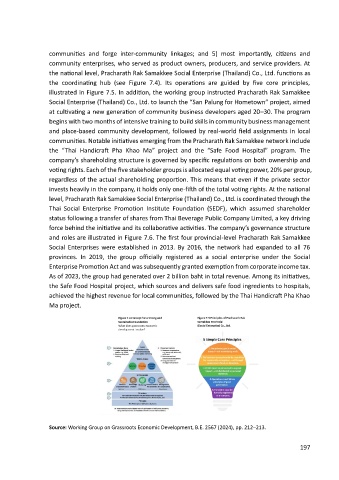
                  the  coordinating  hub  (see  Figure  7.4).  Its  operations  are  guided  by  five  core  principles,
                  illustrated in Figure 7.5. In addition, the working group instructed Pracharath Rak Samakkee
                  Social Enterprise (Thailand) Co., Ltd. to launch the “San Palung for Hometown” project, aimed
                  at cultivating a new generation of community business developers aged 20–30. The program
                  begins with two months of intensive training to build skills in community business management
                  and place-based community development, followed by real-world field assignments in local
                  communities. Notable initiatives emerging from the Pracharath Rak Samakkee network include
                  the  “Thai  Handicraft  Pha  Khao  Ma”  project  and  the  “Safe  Food  Hospital”  program.  The
                  company’s shareholding structure is governed by specific regulations on both ownership and
                  voting rights. Each of the five stakeholder groups is allocated equal voting power, 20% per group,

                  regardless of the actual shareholding proportion. This means that even if the private sector
                  invests heavily in the company, it holds only one-fifth of the total voting rights. At the national
                  level, Pracharath Rak Samakkee Social Enterprise (Thailand) Co., Ltd. is coordinated through the
                  Thai  Social  Enterprise  Promotion  Institute  Foundation  (SEDF),  which  assumed  shareholder
                  status following a transfer of shares from Thai Beverage Public Company Limited, a key driving
                  force behind the initiative and its collaborative activities. The company’s governance structure
                  and roles are illustrated in Figure 7.6. The first four provincial-level Pracharath Rak Samakkee

                  Social  Enterprises  were  established  in  2013.  By  2016,  the  network  had  expanded  to  all  76
                  provinces.  In  2019,  the  group  officially  registered  as  a  social  enterprise  under  the  Social
                  Enterprise Promotion Act and was subsequently granted exemption from corporate income tax.
                  As of 2023, the group had generated over 2 billion baht in total revenue. Among its initiatives,
                  the Safe Food Hospital project, which sources and delivers safe food ingredients to hospitals,
                  achieved the highest revenue for local communities, followed by the Thai Handicraft Pha Khao
                  Ma project.


                  Source: Working Group on Grassroots Economic Development, B.E. 2567 (2024), pp. 212–213.


                                                                                                          197

