


Page 230 - Social Enterprise A New Business Paradigm for Thailand
P. 230
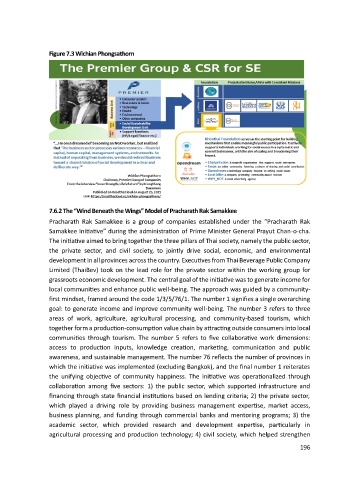
Figure 7.3 Wichian Phongsathorn


                  7.6.2 The “Wind Beneath the Wings” Model of Pracharath Rak Samakkee
                  Pracharath  Rak  Samakkee  is  a  group  of  companies  established  under  the  “Pracharath  Rak
                  Samakkee Initiative” during the administration of Prime Minister General Prayut Chan-o-cha.
                  The initiative aimed to bring together the three pillars of Thai society, namely the public sector,
                  the  private  sector,  and  civil  society,  to  jointly  drive  social,  economic,  and  environmental
                  development in all provinces across the country. Executives from Thai Beverage Public Company
                  Limited (ThaiBev) took on the lead role for the private sector within the working group for

                  grassroots economic development. The central goal of the initiative was to generate income for
                  local communities and enhance public well-being. The approach was guided by a community-
                  first mindset, framed around the code 1/3/5/76/1. The number 1 signifies a single overarching
                  goal: to generate income and improve community well-being. The number 3 refers to three
                  areas  of  work,  agriculture,  agricultural  processing,  and  community-based  tourism,  which
                  together form a production-consumption value chain by attracting outside consumers into local
                  communities  through  tourism.  The  number  5  refers  to  five  collaborative  work  dimensions:

                  access  to  production  inputs,  knowledge  creation,  marketing,  communication  and  public
                  awareness, and sustainable management. The number 76 reflects the number of provinces in
                  which the initiative was implemented (excluding Bangkok), and the final number 1 reiterates
                  the  unifying  objective  of  community  happiness.  The  initiative  was  operationalized  through
                  collaboration  among  five  sectors:  1)  the  public  sector,  which  supported  infrastructure  and
                  financing through state financial institutions based on lending criteria; 2) the private sector,
                  which  played  a  driving  role  by  providing  business  management  expertise,  market  access,
                  business planning, and funding through commercial banks and mentoring programs; 3) the
                  academic  sector,  which  provided  research  and  development  expertise,  particularly  in

                  agricultural processing and production technology; 4) civil society, which helped strengthen
                                                                                                          196

