


Page 184 - Social Enterprise A New Business Paradigm for Thailand
P. 184
The  cooperatives  that  currently  play  the  most  significant  economic  and  social  roles  are
               agricultural cooperatives, savings cooperatives, and credit union cooperatives. Notably, savings

               and credit union cooperatives function as financial institutions for grassroots populations who
               are unable to access services from commercial banks. The rapid growth of these two types of
               cooperatives  in  recent  years  has  introduced  governance  risks,  with  the  potential  to  cause
               widespread harm. In 2019, the government responded by enacting the Cooperative Act (No. 3),
               B.E. 2562 (2019), which added specific provisions for the regulation and oversight of savings and
               credit union cooperatives.

               The  Cooperative  Act  established  the  Cooperative  Development  Fund,  financed  through
               government budget allocations, to assist, promote, and support the development of cooperatives

               and  to  provide  loans  for  investment  and  working  capital.  Oversight  is  conducted  by  the
               Cooperative Registrar, namely, the Director-General of the Department of Cooperative Promotion,
               who  is  responsible  for  both  promoting  and  regulating  cooperative  operations.  Cooperative
               Inspectors are authorized to examine cooperative activities and financial conditions and submit
               their  inspection  reports  to  the  Cooperative  Registrar.  Additionally,  the  Cooperative  Auditing
               Department serves as the official auditor for cooperatives.

               1.1) Tax Obligations of Cooperatives

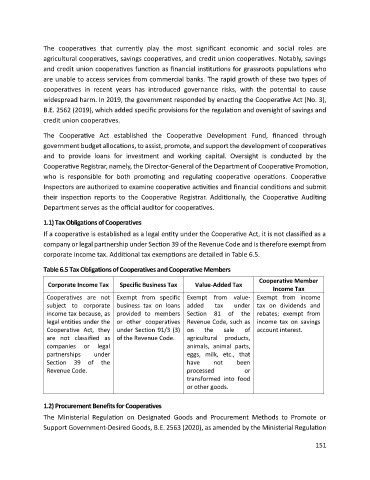
               If a cooperative is established as a legal entity under the Cooperative Act, it is not classified as a
               company or legal partnership under Section 39 of the Revenue Code and is therefore exempt from
               corporate income tax. Additional tax exemptions are detailed in Table 6.5.

               Table 6.5 Tax Obligations of Cooperatives and Cooperative Members
                                                                                       Cooperative Member
                 Corporate Income Tax    Specific Business Tax    Value-Added Tax
                                                                                           Income Tax
                Cooperatives  are  not  Exempt  from  specific  Exempt  from  value- Exempt  from  income
                subject  to  corporate  business  tax  on  loans  added   tax   under  tax  on  dividends  and
                income tax because, as  provided  to  members  Section  81  of  the  rebates;  exempt  from
                legal entities under the  or  other  cooperatives  Revenue Code, such as  income  tax  on  savings
                Cooperative  Act,  they  under Section 91/3 (3)  on   the   sale   of  account interest.
                are  not  classified  as  of the Revenue Code.   agricultural  products,
                companies  or  legal                           animals,  animal  parts,
                partnerships    under                          eggs,  milk,  etc.,  that
                Section  39  of  the                           have     not    been
                Revenue Code.                                  processed          or
                                                               transformed  into  food
                                                               or other goods.


               1.2) Procurement Benefits for Cooperatives
               The  Ministerial  Regulation  on  Designated  Goods  and  Procurement  Methods  to  Promote  or

               Support Government-Desired Goods, B.E. 2563 (2020), as amended by the Ministerial Regulation

                                                                                                         151

