


Page 127 - Social Enterprise A New Business Paradigm for Thailand
P. 127
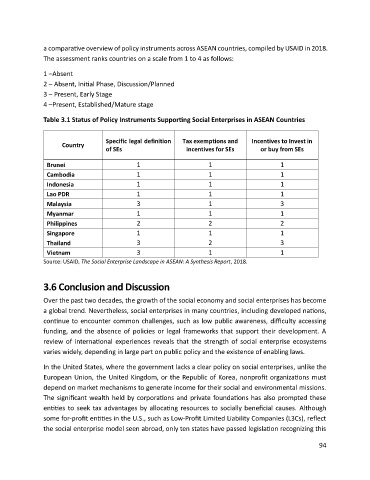
a comparative overview of policy instruments across ASEAN countries, compiled by USAID in 2018.
               The assessment ranks countries on a scale from 1 to 4 as follows:

               1 –Absent

               2 – Absent, Initial Phase, Discussion/Planned
               3 – Present, Early Stage
               4 –Present, Established/Mature stage

               Table 3.1 Status of Policy Instruments Supporting Social Enterprises in ASEAN Countries


                                    Specific legal definition   Tax exemptions and   Incentives to Invest in
                      Country
                                    of SEs                     incentives for SEs      or buy from SEs

                 Brunei                       1                       1                       1
                 Cambodia                     1                       1                       1

                 Indonesia                    1                       1                       1
                 Lao PDR                      1                       1                       1
                 Malaysia                     3                       1                       3
                 Myanmar                      1                       1                       1
                 Philippines                  2                       2                       2
                 Singapore                    1                       1                       1
                 Thailand                     3                       2                       3
                 Vietnam                      3                       1                       1
               Source: USAID, The Social Enterprise Landscape in ASEAN: A Synthesis Report, 2018.


               3.6 Conclusion and Discussion

               Over the past two decades, the growth of the social economy and social enterprises has become
               a global trend. Nevertheless, social enterprises in many countries, including developed nations,

               continue to encounter common challenges, such as low public awareness, difficulty accessing
               funding,  and  the absence  of  policies  or legal  frameworks  that  support  their  development. A
               review of  international  experiences  reveals  that  the  strength  of  social  enterprise  ecosystems
               varies widely, depending in large part on public policy and the existence of enabling laws.

               In the United States, where the government lacks a clear policy on social enterprises, unlike the
               European Union, the United Kingdom, or the Republic of Korea, nonprofit organizations must
               depend on market mechanisms to generate income for their social and environmental missions.
               The significant wealth held by corporations and private foundations has also prompted these

               entities to seek tax advantages by allocating resources to socially beneficial causes. Although
               some for-profit entities in the U.S., such as Low-Profit Limited Liability Companies (L3Cs), reflect
               the social enterprise model seen abroad, only ten states have passed legislation recognizing this

                                                                                                           94

